

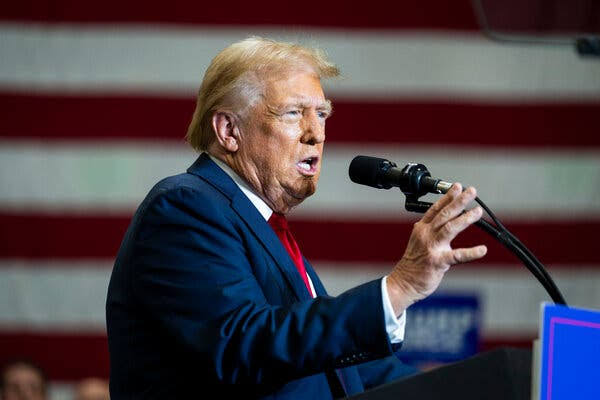
A new political and financial controversy is developing around the United States as President Donald Trump threatens massive tariffs against countries that impose digital services taxes on American companies.
The latest warning has increased concerns about another international trade conflict at a time when investors, businesses and consumers are already dealing with economic uncertainty, inflation risks and changing global trade relationships.
Trump has threatened to impose a 100% tariff on goods imported from countries that introduce digital services taxes targeting American companies.
The controversial proposal could have significant consequences for international trade.
Several countries have considered or introduced taxes designed to collect revenue from large digital companies operating across international borders.
Many of the world’s biggest technology businesses are based in the United States.
The Trump administration argues that digital services taxes unfairly target American companies.
Critics, however, believe aggressive tariff threats could create new trade conflicts, increase consumer prices and damage economic relationships between the United States and its allies.
The latest controversy has created another major political-finance question.
Can tariffs protect American businesses, or could Trump’s aggressive trade strategy eventually create additional problems for the U.S. economy?
Trump’s 100% Tariff Threat Creates New Global Uncertainty
The possibility of 100% tariffs has attracted significant attention because of the enormous potential economic consequences.
A tariff is essentially a tax placed on imported goods.
When the United States imposes tariffs on products entering the country, American importers generally pay the additional cost.
Businesses must then decide how to respond.
Some companies may absorb the additional expense and accept lower profit margins.
Others may increase prices.
This means tariffs can eventually affect American consumers.
Trump has frequently argued that tariffs can protect U.S. companies, encourage domestic manufacturing and provide additional government revenue.
His supporters believe aggressive trade policies can force other countries to negotiate better agreements with the United States.
However, critics argue that tariffs can create significant economic risks.
Countries affected by American tariffs may respond with their own trade restrictions.
This can create a cycle of retaliation.
The result could be higher prices, weaker international trade and increasing uncertainty for businesses.
Why Digital Taxes Have Become a Political Battlefield
The controversy surrounding digital services taxes reflects a much larger global debate.
Traditional tax systems were developed when companies generally conducted business through physical offices, factories and stores.
The digital economy has changed this model.
Technology companies can provide services to millions of customers around the world without maintaining large physical operations in every country.
Governments have therefore faced an important question.
Where should digital companies pay taxes?
Some countries believe large technology businesses should pay additional taxes based on revenue generated from customers within their borders.
The United States has criticized some of these policies.
American officials argue that digital services taxes can unfairly target major U.S. technology companies.
This disagreement has transformed an international tax debate into a political and economic conflict.
Trump’s latest tariff threat significantly increases the stakes.
Instead of relying only on diplomatic negotiations, the administration is threatening potentially massive trade penalties.
American Consumers Could Pay the Price
One of the biggest concerns surrounding tariffs is their potential impact on consumer prices.
Many products sold in the United States depend on international supply chains.
American companies import goods, materials and components from countries around the world.
If tariffs increase the cost of these imports, businesses may increase prices.
Consumers could eventually pay more for products.
The exact impact would depend on which countries are targeted and which goods become subject to tariffs.
However, a 100% tariff represents an extremely large trade penalty.
A product imported at a cost of $100 could face an additional $100 tariff before other expenses are considered.
Businesses would then need to decide whether to absorb the additional cost or increase prices.
This is why economists and investors pay close attention to major tariff announcements.
Trade policy can directly influence inflation.
Federal Reserve Could Face Another Inflation Problem
The tariff controversy could also create new challenges for the Federal Reserve.
The central bank has spent years attempting to control inflation.
Investors have been hoping that improving inflation conditions could eventually allow policymakers to adopt a more supportive monetary policy approach.
However, aggressive tariffs could complicate this situation.
If tariffs increase the cost of imported goods, consumer prices could rise.
Businesses facing higher expenses may also increase prices to protect their profit margins.
This could create additional inflationary pressure.
The Federal Reserve would then face a difficult decision.
Keeping interest rates high could create pressure on economic growth and employment.
Reducing rates too quickly could potentially increase inflation.
Political trade decisions could therefore have significant consequences for monetary policy.
Wall Street investors will closely monitor whether tariff threats remain negotiating strategies or eventually become actual trade restrictions.
Big Tech Is Caught in the Middle of the Conflict
American technology companies are at the center of the digital tax controversy.
The United States is home to many of the world’s largest technology businesses.
These companies generate significant amounts of revenue from customers in international markets.
Foreign governments want to ensure that digital companies contribute tax revenue in countries where they conduct business.
The United States, however, is concerned that some digital taxes disproportionately affect American businesses.
This disagreement creates an extremely complicated situation.
Technology companies want access to global markets.
They also want predictable tax and trade policies.
A major international conflict over digital taxation could create additional expenses and regulatory uncertainty.
American technology companies could face new taxes overseas.
At the same time, retaliatory tariffs could damage international trade relationships.
The situation demonstrates how closely technology, politics and global finance have become connected.
Could Other Countries Retaliate Against the United States?
One of the biggest risks surrounding Trump’s tariff strategy is retaliation.
International trade conflicts rarely involve only one country taking action.
Governments affected by American tariffs could respond with their own restrictions.
They could impose tariffs on U.S. exports.
They could introduce additional regulations targeting American companies.
They could also strengthen trade relationships with other countries.
This could create problems for American exporters.
Farmers, manufacturers and technology businesses depend on international customers.
If foreign governments introduce retaliatory policies, U.S. companies could experience weaker demand.
A prolonged trade conflict could therefore damage businesses on both sides.
This is why financial markets generally prefer predictable trade policies.
Companies make investment decisions based on expectations about costs, regulations and market access.
Sudden political changes can create significant uncertainty.
Wall Street Faces Another Political Risk
Investors are already dealing with several major challenges.
The U.S. economy is showing mixed signals.
Employment growth has created concerns.
Oil prices and geopolitical tensions are increasing uncertainty.
Artificial intelligence stocks continue experiencing significant volatility.
Now trade policy has added another risk.
Tariff announcements can create rapid movements across financial markets.
Companies that depend heavily on international supply chains may experience pressure.
Export businesses could also face risks if other countries introduce retaliatory measures.
Currency markets may react to changing trade expectations.
Government bond markets could be influenced by inflation concerns.
The result could be increased volatility across Wall Street.
Investors will therefore pay close attention to negotiations between the United States and countries considering digital services taxes.
Are Tariffs Becoming America’s Most Powerful Political Weapon?
Trump’s trade strategy represents a major change in how the United States uses economic power.
Tariffs were traditionally viewed primarily as trade policy tools.
Under Trump, they have increasingly become political negotiating weapons.
The administration has used tariff threats to pressure other countries on economic and political issues.
Supporters believe this strategy takes advantage of America’s enormous consumer market.
Countries want access to U.S. customers.
The threat of losing that access can create significant negotiating pressure.
Critics argue that using tariffs too aggressively could eventually damage the American economy.
Countries could reduce their dependence on U.S. markets.
Businesses could move supply chains.
International relationships could become increasingly unstable.
The long-term consequences remain uncertain.
Could This Trigger a New Global Trade War?
The biggest question is whether the latest tariff threat could contribute to a broader global trade conflict.
A full-scale trade war could have significant economic consequences.
International trade could decline.
Consumer prices could increase.
Business investment could slow.
Global supply chains could face disruption.
Financial markets could experience significant volatility.
However, tariff threats do not always become permanent trade policies.
Governments sometimes use aggressive announcements to create negotiating pressure.
The United States and affected countries could eventually reach agreements.
Much will depend on future diplomatic negotiations.
Investors will closely monitor whether Trump follows through on the 100% tariff threat.
What Investors Should Watch Next
The coming weeks could provide important information about the future of U.S. trade policy.
Investors should watch negotiations surrounding digital services taxes.
Any country that moves forward with new taxes on American technology companies could potentially face U.S. trade retaliation.
Wall Street will also monitor inflation.
If tariff policies increase consumer prices, Federal Reserve expectations could change.
Technology companies could become another important focus.
Businesses operating internationally may provide information about how digital taxes and trade restrictions are affecting their financial performance.
Political developments in Washington could also influence market sentiment.
Trade policy has become one of the most important connections between politics and finance.
Conclusion
Donald Trump’s threat to impose 100% tariffs on countries implementing digital services taxes has created another major political and financial controversy.
The administration argues that these taxes unfairly target American technology companies.
Critics warn that aggressive tariffs could increase consumer prices, create inflation and trigger retaliation from other countries.
The controversy highlights the growing connection between technology, taxation, politics and global trade.
For American consumers, the biggest concern is whether tariffs could increase prices.
For businesses, the main challenge is uncertainty.
For the Federal Reserve, additional inflationary pressure could complicate future interest rate decisions.
And for Wall Street, another global trade conflict could create significant market volatility.
The biggest question is whether Trump’s 100% tariff threat will remain a negotiating strategy or become the beginning of a much larger economic confrontation.
The answer could have major consequences for American technology companies, global trade and the U.S. economy.
As political tensions surrounding digital taxes continue, investors should prepare for trade policy to remain one of the most controversial and influential financial stories of 2026.