

Introduction
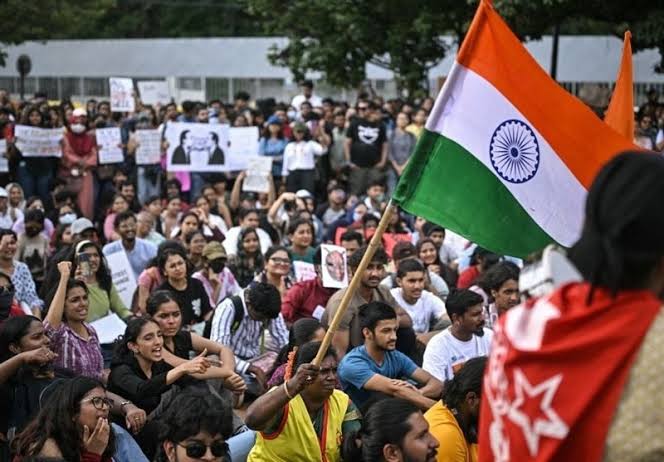
The student protests that have gathered momentum around Delhi’s Jantar Mantar are being viewed primarily as a political and education story. But beneath the slogans, marches and confrontations lies a much larger economic question for India.
What happens when millions of young people spend years preparing for competitive examinations but gradually lose confidence in the systems that are supposed to determine their future?
The ongoing Cockroach Janta Party, or CJP, movement has brought frustrations over examination irregularities and the future of young Indians into national focus. What began as a youth-driven protest movement has expanded into a broader public debate about accountability, opportunity and the relationship between India’s education system and its economy.
For financial markets, the immediate impact of a student protest may appear limited. The Sensex does not necessarily fall because students gather at Jantar Mantar. The rupee does not automatically weaken because young people demand examination reforms.
But that is not where the real economic risk lies.
The deeper issue is human capital.
India is one of the youngest major economies in the world. Its demographic advantage is frequently presented as one of the strongest arguments for the country’s long-term growth story. A large working-age population can increase productivity, consumption, tax revenue, entrepreneurship and investment.
But a young population becomes an economic advantage only when young people can move efficiently from education into productive employment.
If that transition becomes slow, expensive or unreliable, the demographic dividend can begin to weaken.
For many Indian families, competitive examinations are not simply tests. They represent years of financial and emotional investment.
Parents pay for coaching institutes, accommodation, books, online courses, transportation and application fees. Some students move hundreds of kilometres away from their homes to prepare for a single examination.
A middle-class or lower-income family may spend a substantial part of its savings on a child’s education because the family believes that a medical seat, government position or professional qualification can transform its economic future.
When an examination is delayed, cancelled or questioned because of alleged irregularities, the financial damage goes beyond the cost of one application form.
Another year of preparation can mean another year of coaching fees.
Another year without employment.
Another year of rent.
Another year in which the student is financially dependent on the family.
Multiply that experience across millions of aspirants and the issue begins to look less like an isolated education controversy and more like an economic problem.
The CJP protests have therefore arrived at an important moment for India.
The country wants to become a larger global manufacturing power, attract international investment and build leadership in technology, artificial intelligence and other advanced industries.
Achieving those goals will require roads, factories and capital.
But it will also require something even more fundamental: young Indians who believe that education, skills and hard work can produce a fair opportunity to move forward.
India’s Competitive Exam Economy Is Bigger Than It Looks
Competitive examinations have created an enormous parallel economy in India.
Across cities such as Kota, Delhi, Prayagraj, Patna, Hyderabad and many other education hubs, entire local business ecosystems depend on students preparing for entrance tests and government recruitment examinations.
There are coaching institutes, hostels, paying guest accommodation, libraries, bookstores, food businesses and online education platforms.
For some cities, students are not simply residents. They are a major source of economic activity.
This industry exists because competition for desirable opportunities is intense.
A limited number of medical seats can attract enormous numbers of applicants. Government vacancies can receive applications from candidates far beyond the number of available positions.
The result is a system in which young people can spend several of their most productive early adult years preparing for examinations.
There is nothing inherently wrong with competition.
Competitive examinations can provide a transparent method of selecting candidates when they are conducted efficiently and fairly.
The economic problem begins when the process becomes unpredictable.
An aspirant who knows that an examination will take place on a specific date can plan financially.
A family can estimate how much preparation will cost.
A student can decide how many attempts to make before pursuing another career.
Uncertainty destroys that planning.
If a student believes an examination process may be compromised, the value of every rupee spent on preparation becomes less certain.
This can create what economists might describe as a confidence problem.
Financial systems depend on confidence, and education systems do too.
Investors put money into markets because they believe rules will be followed.
Businesses build factories because they believe contracts will be respected.
Families invest in education because they believe effort and qualifications will create economic opportunity.
When confidence weakens, behaviour changes.
A family may decide that spending another ₹2 lakh on coaching is no longer worthwhile.
A talented student may begin looking for opportunities abroad.
Another young person may abandon years of preparation and accept work far below his or her skill level.
Individually, these decisions may appear small.
Collectively, they can reduce the efficiency of the economy.
India cannot afford to waste large amounts of young talent.
The country is competing with China, the United States, Europe and emerging Asian economies for investment and technological leadership.
International companies evaluating India look at more than tax rates and labour costs.
They also look at the quality of the workforce.
Can companies find skilled engineers?
Can hospitals find trained medical professionals?
Can manufacturers hire technicians?
Can financial companies recruit capable analysts?
Can growing businesses find managers?
The education system sits at the beginning of this entire economic chain.
When students protest about examination integrity, therefore, they are raising an issue that ultimately connects to the labour market.
The question is whether India’s systems are moving young people into productive careers quickly enough.
Every additional year spent waiting for an examination or repeating a recruitment process has an opportunity cost.
A 23-year-old preparing full time for an exam is usually not earning a full-time salary.
That means lower personal income.
It can also mean lower household consumption.
The student may postpone buying a vehicle, renting an independent home, getting married or making other major financial decisions.
These delayed decisions affect businesses.
Housing demand, consumer goods, financial services and discretionary spending are all influenced by the economic confidence of young adults.
This is why youth employment matters far beyond unemployment statistics.
A young person with a stable income becomes a consumer.
A consumer becomes a potential borrower, taxpayer, investor and homeowner.
When millions of young people remain financially uncertain for longer periods, the effects can spread across the economy.
Why Youth Frustration Can Become a Long-Term Economic Risk
India’s demographic profile is often described as an economic superpower waiting to be fully unlocked.
That description contains an important assumption.
It assumes that the economy will create enough productive opportunities for the young population entering the workforce.
Demographics alone do not guarantee prosperity.
A country benefits from a young population when workers are educated, skilled and employed in productive sectors.
If jobs fail to keep pace with expectations, the same demographic structure can create social and political pressure.
The CJP protests should be understood within this wider context.
Not every person participating in a protest has the same motivation. Some are focused specifically on examination irregularities. Others may be expressing broader dissatisfaction with education and employment opportunities.
But the scale of attention surrounding the movement shows how strongly these issues resonate with young Indians.
The financial risk is not that protests themselves will suddenly damage India’s GDP.
The risk is that the underlying frustrations represent structural weaknesses that remain unresolved.
One of those weaknesses is the mismatch between qualifications and employment.
India produces large numbers of graduates every year, but a degree does not always guarantee a job matching the graduate’s education.
This creates underemployment.
A person may technically have a job while earning significantly less than expected or working in a role that does not use his or her qualifications.
Underemployment is economically important because education represents an investment.
Families spend money and students spend years developing skills.
If those skills are not used productively, the economy receives a lower return on that investment.
Government jobs have traditionally been viewed as particularly attractive because they offer stability, social status and predictable income.
That attraction becomes even stronger when private-sector employment feels uncertain.
The result is intense competition for a relatively limited number of government positions.
This creates an unusual economic cycle.
Young people spend years preparing for government jobs partly because they want security.
But the years spent preparing can themselves create financial insecurity.
Some aspirants eventually succeed.
Many others do not.
Those who leave the examination cycle after several years may then enter the private job market later than their peers.
The economy needs better pathways between education, skills and employment so that one failed examination does not become a financial disaster.
Vocational education can play a role.
Apprenticeships can play a role.
Private-sector job creation is essential.
Entrepreneurship can also provide opportunities.
But these alternatives must be credible.
Telling young people to become entrepreneurs is not enough if they lack access to capital, customers or practical business skills.
Similarly, telling graduates to enter the private sector does not solve the problem if available jobs provide extremely low wages with limited career progression.
The quality of employment matters.
This is where the issue connects directly with India’s consumption story.
Domestic consumption is one of the most important engines of the Indian economy.
Companies invest because they expect hundreds of millions of consumers to increase their spending as incomes rise.
Banks expect demand for home loans, vehicle loans and credit products.
Real estate developers expect young families to purchase homes.
Consumer companies expect new middle-class households to buy appliances, smartphones and other products.
All of these expectations depend on income growth.
If a significant share of educated young people remains economically insecure, consumption growth can become weaker than expected.
That does not mean the CJP protests will cause a national economic slowdown.
The connection is more fundamental.
The protests are a warning signal about the expectations of the generation that is supposed to power India’s future consumption and productivity.
Ignoring that signal would be economically short-sighted.
What the Government’s Response Could Mean for India’s Growth Story
For the government, the most effective economic response to student frustration would not simply be ending a protest.
It would be strengthening confidence in the systems that connect education to opportunity.
Examination integrity is the obvious starting point.
Modern technology should make it increasingly possible to create stronger security systems around major examinations.
Digital monitoring, secure question-paper distribution, transparent investigation procedures and faster dispute resolution could reduce uncertainty.
But technology alone cannot solve every problem.
Accountability matters.
If students believe there are serious irregularities, authorities need processes that are fast enough to protect candidates from losing valuable years of their lives.
A legal or administrative investigation that takes several years may eventually produce a correct answer, but the student who lost those years cannot recover the time.
Speed therefore has economic value.
The second challenge is recruitment.
Government vacancies should ideally follow predictable schedules.
Delays create uncertainty not only for applicants but also for government departments that need employees.
A more predictable recruitment calendar could help students make better career decisions.
The third and much larger challenge is private-sector employment.
No government can solve youth employment by creating government jobs for everyone.
India’s population is simply too large.
The sustainable solution must involve large-scale private-sector job creation.
Manufacturing is particularly important.
India has ambitions to become a major alternative manufacturing destination as global companies diversify supply chains.
If successful, this could create employment across different skill levels.
But manufacturing growth requires more than attracting a few large factories.
A strong industrial ecosystem needs thousands of suppliers and smaller businesses.
Small and medium-sized enterprises can become major job creators if they have access to financing, reliable infrastructure and predictable regulation.
Services will remain equally important.
Technology, healthcare, tourism, financial services, logistics and professional services can create millions of jobs.
However, education and training must keep pace with the skills employers actually need.
This is where government spending becomes relevant.
India already spends significant resources across education and skills programmes, but the quality of outcomes matters as much as the amount of money spent.
A government can increase an education budget without solving the employment problem.
The better question is whether spending improves employability.
Are students learning skills businesses need?
Are universities connected to industry?
Are apprenticeship programmes leading to real jobs?
Are rural students receiving the same access to opportunity as students in major cities?
These questions will become increasingly important for investors as well.
Foreign investors are attracted to India’s scale.
A young population is one of the country’s biggest advantages.
But investors also want stability.
Persistent large-scale youth frustration can eventually become a political risk if people believe economic opportunities are unfair or inaccessible.
Again, this does not mean one protest will cause foreign companies to leave India.
India’s economy is far too large and diversified for such a simple conclusion.
But long-term investor confidence depends partly on institutional quality.
Transparent examinations, efficient courts, predictable regulations and reliable government processes all belong to the same broader category: institutions that people can trust.
Strong institutions reduce economic friction.
Weak institutions increase it.
The CJP movement has therefore created an opportunity for policymakers.
If the government responds with credible reforms, the controversy could ultimately strengthen the examination system.
A crisis can expose weaknesses that might otherwise remain ignored.
The danger is allowing the issue to become purely political.
Once every side treats student frustration only as an electoral weapon, the original economic problem can disappear beneath partisan arguments.
Students need functioning systems more than political slogans.
Businesses need skilled workers.
Families need confidence that education remains worth investing in.
India needs young people to enter productive employment.
These interests are not fundamentally in conflict.
Conclusion
The CJP student protests at Jantar Mantar are about examinations, accountability and the frustrations of young Indians.
But the economic story behind the movement is much larger.
India’s future growth depends heavily on its youth.
The country has one of the world’s largest young populations at a time when many developed economies are struggling with ageing workforces.
That demographic advantage could support decades of economic expansion.
Young workers can increase production.
Young families can drive housing demand.
Rising incomes can support consumer spending.
New entrepreneurs can build businesses.
A growing tax base can strengthen government finances.
But none of this happens automatically.
Young people must have credible pathways from education to employment.
When students spend years preparing for competitive examinations, their families are making a financial investment.
They are investing money, time and hope in the expectation that a fair system will reward successful candidates.
If confidence in that process weakens, the damage cannot be measured only by cancelled examinations or application fees.
The larger cost is lost time.
A year spent waiting is a year of potential income that may never be recovered.
For one student, that can be painful.
Across millions of young people, it becomes economically significant.
The protests should therefore encourage a broader national conversation about what India expects from its education and employment systems.
Examination reforms are important, but they are only one part of the solution.
India also needs more high-quality private-sector jobs, stronger vocational training, better links between universities and employers, predictable government recruitment and faster systems for resolving examination disputes.
The financial markets may not react dramatically to demonstrations at Jantar Mantar.
But investors should pay attention to what the protests represent.
India’s long-term economic valuation is built partly on the belief that its young population will become a productive and increasingly prosperous workforce.
If that happens, India could remain one of the world’s most important growth stories for decades.
If large numbers of educated young people instead remain trapped between repeated examinations, uncertain recruitment and inadequate employment opportunities, the country’s demographic advantage will not reach its full potential.
That is why the current youth movement matters economically.
The real question is not whether the protests continue for another week or another month.
The real question is whether the frustration behind them leads to meaningful institutional change.
A country with India’s ambitions cannot afford an education system in which young people lose confidence in the fairness of opportunity.
Nor can it afford an economy where millions of capable young adults spend their most productive years waiting indefinitely for a limited number of jobs.
India has the talent.
It has the population.
It has growing international investment and expanding economic influence.
The challenge now is converting those advantages into opportunity at the individual level.
For policymakers, that means treating examination integrity and youth employment as economic priorities rather than isolated education issues.
For businesses, it means investing in skills and creating career paths that make private employment more attractive.
For financial markets, it means recognising that the strength of India’s economy over the next twenty years will depend not only on GDP numbers, infrastructure projects or stock market valuations.
It will depend on whether today’s students become tomorrow’s productive workers, consumers, taxpayers, investors and entrepreneurs.
The demonstrations at Jantar Mantar may eventually end.
The economic questions they have brought into focus will remain.
And how India answers those questions could help determine whether its enormous youth population becomes the powerful demographic dividend the country has long been promised—or one of the biggest missed economic opportunities of the coming decades.